Introduction
In Part 1 we talked about lowpass and highpass filters using image parameter or "Constant-K" design. Let's continue on image parameter design but add the topics of m-derived half-sections and bandpass filter designs.
M-Derived Half-Sections
Let's start out with a lowpass half-section. If we were to split the inductor in this lowpass half-section, leaving part (m of it) in the series path and putting some ( (1-m^2)/m of it) in the shunt path, and leaving part of the shunt capacitor (m of it) in the shunt path, we can create an "m-derived" half-section (Figure 1). With m chosen at about 0.6, a lowpass filter with this half-section on each end has a couple of interesting properties. First, the SWR in the passband is better over wider frequency range. Second, there is a notch in the stopband (actually one from each m-derived end section) at about 1.25 times the cutoff frequency, resulting in a faster rolloff. This is shown in the following example.
Example: 5-pole lowpass, 50 ohms, 40 MHz cutoff, with and without end-sections.
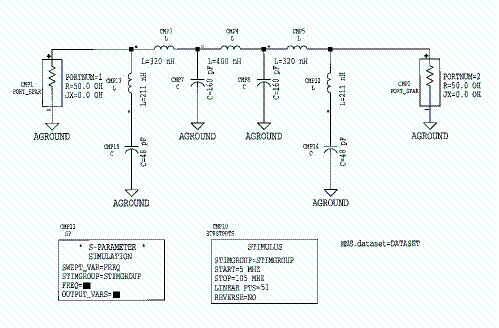
Here the basic design yields L = 0.2 uH and C = 80 pF for the half-section. If we choose m=0.6, we can derive a section that has Lsm = 0.12 uH and Cpm = 48 pF and Lpm = 0.211 uH.
The lowpass filter performance without the m-derived end sections is sketched in Figure 2, Figure 3, and Figure 4. The lowpass filter performance with the end sections added is sketched in Figure 5, Figure 6, and Figure 7. Note the improvement.
These filters are not hard to design and make a lot of intuitive sense. Sometimes in just copying a design, the "feel" is lost. Maybe something works, but we don't really know why.
By the way, the m-derived half-section can be created for a lowpass using capacitor input image parameter sections. Here a parallel L-C tank is put in the series arm with (m * L) as the inductor and (1-m^2)/m * C as the capacitor. The shunt arm just has a capacitor of value (m * C). The shunt C's from this end section and the prototype main section would be paralleled.
Bandpass Filters
Bandpass filter designs can be used as IF filters or as clean up filters for transmitters. I use one as part of a 17 meter QRP transmitter ... fewer inductors to wind and higher out-of-band rejection. Just a constant-k design with only three resonators was plenty. Here's how to do it.
Let's create a half-section again, this time with a series L-C in the series arm and a parallel L-C in the shunt arm. As you can see, if the series circuit's resonant frequency and the shunt circuit's resonant frequency is the center frequency of the band we want to pass, then we have created a bandpass filter. If we choose the series inductor's reactance AT A FREQUENCY EQUAL TO THE DESIRED BANDWIDTH and the shunt capacitor's reactance AT A FREQUENCY EQUAL TO THE DESIRED BANDWIDTH equal to our characteristic impedance, and pick the paired L and C to resonate with them at our desired center frequency, then we have designed a bandpass filter. Let's look at the 17 meter filter as an example.
Example: 3-pole bandpass filter, centered at 18 MHz, 6 MHz wide, 50 ohms.
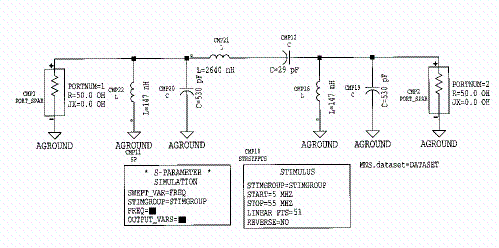
The series inductor ... Ls = 50/(2*3.14*6E6) = 1.327 uH, and the shunt capacitor Cp = 1/(50*2*3.14*6E6) = 530 pF.
Now the series arm capacitor must have the same reactance at 18 MHz as the series arm inductor ... 150 ohms. The same applies to the shunt arm ... 16.7 ohms.
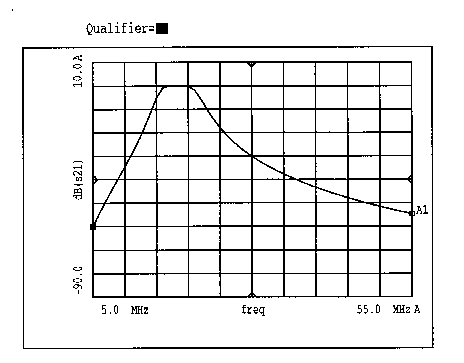
So ... Cs = 59 pF and Lp = 0.147 uH. I wound these three inductors using three T50-6 toroid cores. The filter's performace is shown in Figure 8, Figure 9, and Figure 10.
Tolerances
Many circuits do not require high tolerance in center frequency or cutoff frequency and need high tolerance or tunable parts. For instance, take the 3-pole bandpass we just looked at. For a Q=3 (F center / F bandwidth ) kind of a circuit, 5% parts were adequate. In fact, 5% parts give a 5% tolerance on center frequency and/or cutoff frequency. For Q<5 (20% fractional bandwidth), 5% parts should be totally acceptable.
Conclusion of Part 2
In Part 2, we have looked at m-derived sections for lowpass filters and bandpass filter designs. Part 3 is going to look into lowpass prototype filters, transformation to highpass and bandpass, and frequency scaling and impedance scaling.